
We find problems worth dedicating your career to.
The biggest challenge for founders isn’t just building a charity. It’s knowing what to build.
Our research team identifies the most promising opportunities for impact, providing founders with the ideas and evidence to build high-impact charities.


How it works
Our research team spends 5000+ hours each year identifying and evaluating potential charity opportunities. Ideas come from experts, existing research and our own investigation before being funnelled through increasingly rigorous rounds of inquiry.
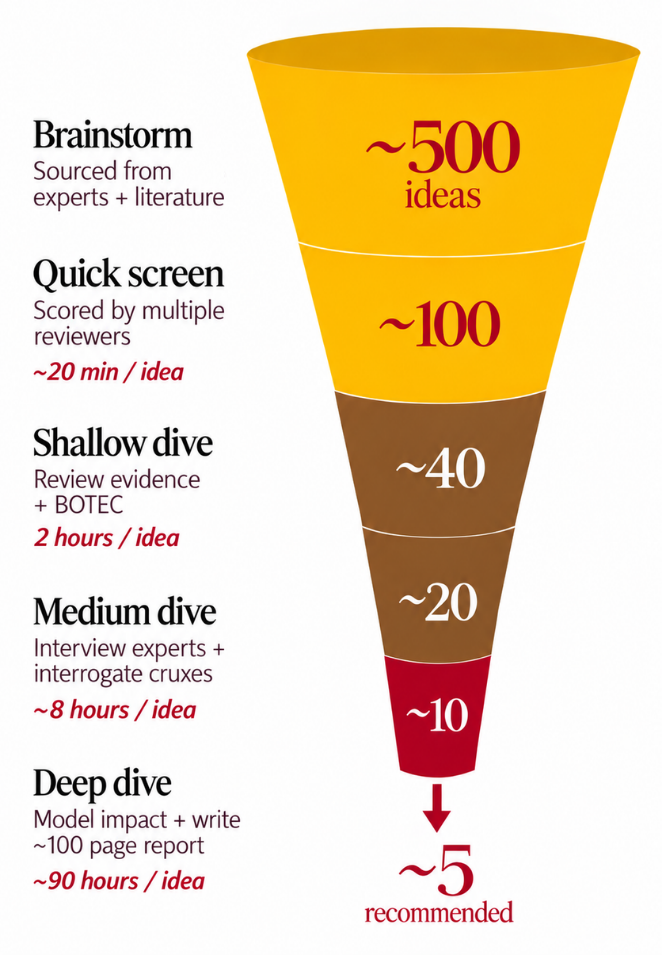
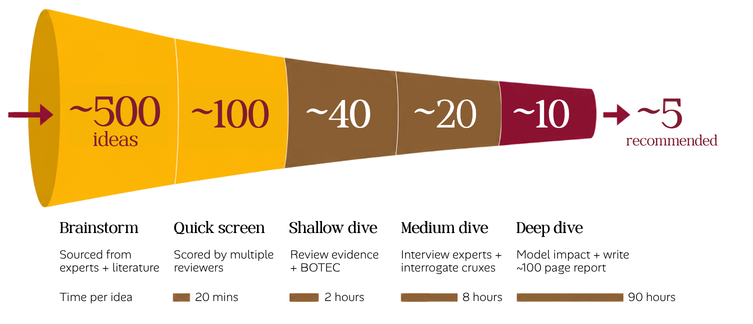
The ideas that survive scrutiny become open-access research and implementation reports, giving founders the evidence they need to build effective charities.


Our recommended charities
LATEST RECOMMENDATIONS
-

Simulation-based training for emergency obstetric and newborn care
-

Treating depression with guided digital self-help programs
-

Reducing diet-related disease through taxes on sugary drinks
Simulation-based training for emergency obstetric and newborn care
In short:
In low-resource settings, getting quality care during birth is very difficult. When things go wrong during a birth, a handful of techniques can be deployed safely to drastically reduce the chances of death for both mom and baby. Medics are often unprepared and have insufficient practice applying these. This organization will partner with healthcare providers to strengthen emergency obstetric and newborn care through low-dose, high-frequency, hands-on simulation-based training in basic procedures that can prevent long-lasting disability or death, supported by ongoing mentorship and supervision.
The Problem
In low-resource settings, mothers and babies often receive too little care, too late. In some settings, timely access to well-equipped, evidence-based care maternal and neonatal care remains limited (Miller et al., 2016).
Maternal and neonatal outcomes differ starkly between low- and high-income countries. A baby born in a high-income country has a 0.3% chance of dying in their first 28 days of life, compared with 2.6% for a baby born in a low-income country (Our World in Data, 2026b, 2023 data)
The Solution
What’s the proposed solution?
The organization is expected to manage a team of master trainers who train and support selected facility staff (in-facility champions) to run weekly refresher simulation and practice sessions for skilled birth attendants.
The selected staff receive ongoing coaching and mobile phone-based support to help them maintain these sessions throughout the year. The repeated practice is expected to help skilled birth attendants maintain their clinical skills and apply them during maternal and newborn emergencies.
We trust this strategy because it has worked before in diverse settings, and the practices being trained have a large amount of high-quality evidence backing them.
We estimate that an organization implementing a strategy like this one in well-chosen settings will avert a year of disability for less than one hundred dollars.
Treating depression with guided digital self-help programs
In short:
Depression is one of the leading causes of disability worldwide, affecting more than 300 million people. The burden falls disproportionately on LMICs, where access to care is extremely limited, and there are severe shortages of trained providers. Scaling proven digital solutions for self-help can help alleviate this large and growing burden.
The Problem
Depression is one of the leading causes of disability worldwide
Over 300 million people are affected globally, with LMICs bearing the majority of the burden
The WHO estimates that around 75% of people with depression in LMICs receive no treatment
The Solution
What’s the proposed solution?
A digital guided self-help program based on WHO’s Step-by-Step model
Participants would complete short, structured self-help modules via WhatsApp. Meta analyses show guided self-help achieves effects comparable to face-to-face therapy in many settings
Five randomized controlled trials of Step-by-Step in LMICs show statistically significant improvements over enhanced usual care
Reducing diet-related disease through taxes on sugary drinks
In short:
Consumption of sugary drinks is a major contributor to rising rates of diabetes, cardiovascular disease, and poor oral health worldwide. Well-designed taxes have been shown to reduce consumption and encourage product reformulation. A new organization could support governments to adopt and sustain effective sugary drink taxes in countries where policy action has been limited
The Problem
Sugary drinks are linked to obesity, type 2 diabetes, cardiovascular disease, and poor oral health
Despite strong evidence of their effectiveness in decreasing their consumption, sugary drink taxes remain underused
The Solution
What’s the proposed solution?
Advocating for and supporting the adoption of WHO-recommended 20% taxes on sugary drinks in countries that are yet to take action.
These types of taxes have already been implemented in over forty countries, across all income levels]
Evidence of the direct impact of these taxes on long-term health outcomes is more limited, but the link between lower consumption and improved health is well established.


All Research
You can browse the full database of charity ideas we’ve thoroughly researched below. Our animal welfare charity ideas are available on request at morgan@ambitiousimpact.com
